
121 West Lincoln Street
Builder Oliver M. Palmer
Born: January 28, 1821 in Northeast Erie Co., PA
Died: March 22, 1898
Married: Huldah Hall
Parents: Daniel and Beulah Warner Palmer
Children: Mary Palmer Kierstead, daughter
Cassius and John, sons
Oliver Palmer, a prominent figure in the early history of the Methodist Episcopal church of Oregon, came to Wisconsin in September, 1853. He owned and farmed several farms in the township of Oregon where he served as a Supervisor in 1855 and 1871. He took no active part in politics until the breaking out of the Civil War, when he became exceedingly influential in the matter of raising troops. He sold his farm in 1878 when he and his wife settled in the Village. They built and lived in one of the finest of the many pleasant homes in the Village.
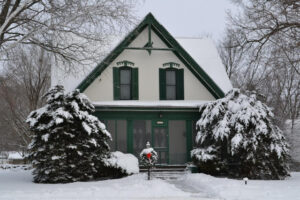
This Gothic Revival style residence is located at the eastern edge of the district on the north side of the street. Built c. 1879, the cross-gable brick house is one-and-one-half stories, has a central brick chimney and rests on a stone foundation. Each of the four steeply pitched gables is identical and features a triangular vent near the gable apex, decorative bargeboards, and kingposts. A flat-roof screened-in-porch with the original balustrade spans the facade.
The front (south) facade has twin entrance doors, each with two panels and transoms. The front entrances are flanked by original fixed-frame picture windows with headers. Windows are predominantly replacement one-over-one double-hung sash with segmental arch lintels, stone sills, decorative hoods with protruding keystones and arched brickwork and louvered shutters. Small decorative detailing is incised into the head of each window frame, just below the lintel. Basement windows have been downsized.
A flat-roof portion with a decorative cornice and replacement support posts is located on the east elevation. It shelters a two-light door with a header that is accented with a segmental arch lintel and keystone.
A c. 1970 flat-roof brick addition is attached to the rear elevation. Windows on the addition are fixed on the top and awning on the bottom. A one-panel, one-light door is located on the west elevation and sliding glass patio doors on the north elevation open to a modern redwood deck. The addition does not detract from the historic integrity of the house. It is brick construction and windows are arched and similar in size to windows on the historic section of the house. The brick on all elevations has been painted white.
A c. 1900 contributing horse barn with a shed roof rear addition is also located on the property. It has been converted into a garage and two overhead doors are located on the facade.