 This page contains information found in Oregon School District: Rural & Village Schools (1846-1998) by Florice Paulson available for purchase from the General Store. Also available for purchase is an ornament of the Red Brick School House.
In the 1830s and 1840s emigrants from New York, Vermont, Pennsylvania, and Ireland arrived in our area. German, Danish, Norwegian, and other settlers followed. The majority of the new families had come from regions where schools had been an important part of their heritage. It was imperative, therefore, that they provide facilities for their children to receive an education. After these early settlers cleared the land for building shelters, the need for schools became a priority

It was the custom for a farmer to deed an acre of land to the school district for the school with the stipulation that, upon the dissolution of said district and need for a school, the land would revert back to the original owner. The schools were named either for the donor or the topography of the land.
The one-room school in the rural areas become not only the source of learning the essentials needed to survive and progress in their “new world,” but also supplied the young students with a knowledge of the world beyond their small area. In 1845 a bill to the territorial legislature became law, authorizing all legal voters of a town to vote taxes on all assessed property for full support of schools. In the fall of 1845 the first free schools in the state were legally organized. Slowly, year by year, new measures were adopted by the legislature and passed on to the small rural and village schools giving them authority under a state and county superintendent to govern themselves.
Much more information about rural schools in Rutland can be found in the Oregon School District booklet published by the Oregon Area Historical Society.
Over the years, the school grew steadily and there were numerous one-room rural schools. Over time, schools consolidated with Oregon. Most rural schools closed in the 1920s or 1930s due to low enrollment. Students were then transported to Oregon by bus, wagon, or in one case, a converted hearse.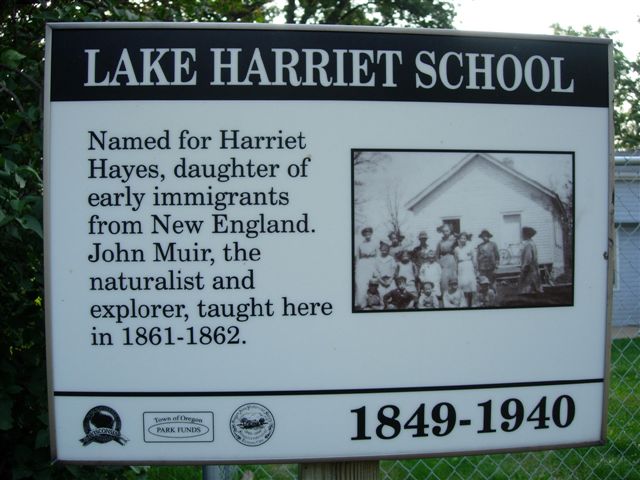
Early Village Schools – 1860’s
The first known school in the Village of Oregon was just east of the viaduct on Jefferson Street. This temporary structure was replaced with a building on what is now the site of the Catholic Church (1856-57).
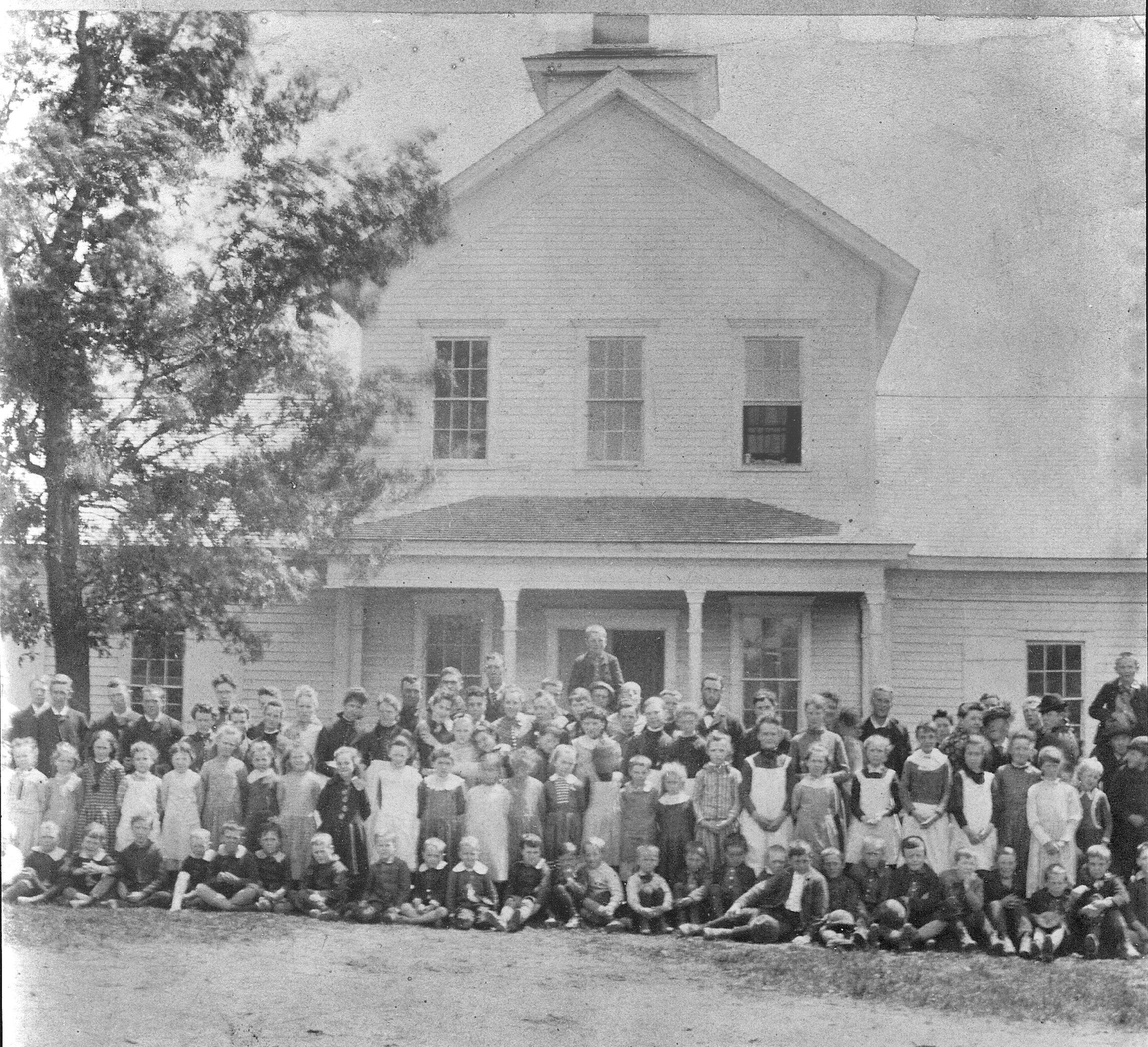
As the village became more populated and more centralized, a one-room school was built in 1861 (area of current elementary school). Then with the increased enrollment, wings were added to the main building and the main building became two stories (1867).
When it came time to build another school in 1895, this one pictured, was divided into three sections. The center section was moved to the site where Maria’s Pizza is now located. It became the Village Hall. The two side wing sections were moved to North Main Street and became homes at 414 N. Main and 418 N. Main. The center section was moved to South Main Street, behind the Netherwood block, and served as the Village Hall. The two side wing sections were moved to North Main Street and became homes at 414 North Main and 418 North Main.
Oregon High School, 1895
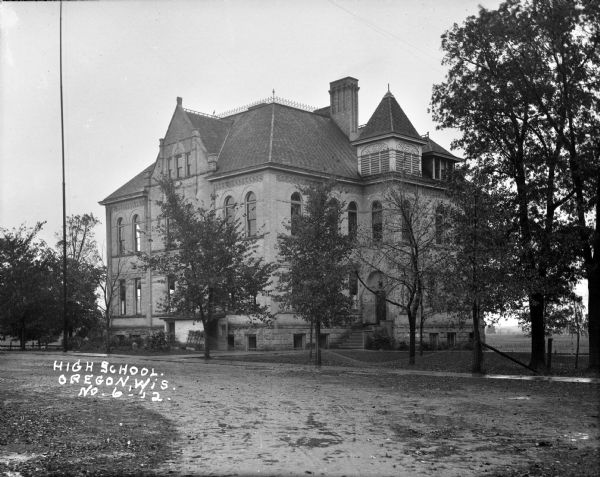 In 1895, a new two-story, tan brick high school was built (site of current Netherwood Knoll school) at a cost of $12,000-$14,000. While construction was underway, children attended classes in church basements and other borrowed spaces.
This school was built for first grade through high school students. The two-story, six-room tan brick building could accommodate 305 pupils. There was no kindergarten in those early years, but was added in 1912.
The first occupants included 224 pupils and six teachers. It had a huge attic, which was later used for classes. Students outside the village could opt to attend this school if they paid tuition. All students purchased their own books. At that time the principal’s salary was $100/month; the teachers made between $25 and $88/month.
This building was torn down in 1966.
Red Brick School, 1922
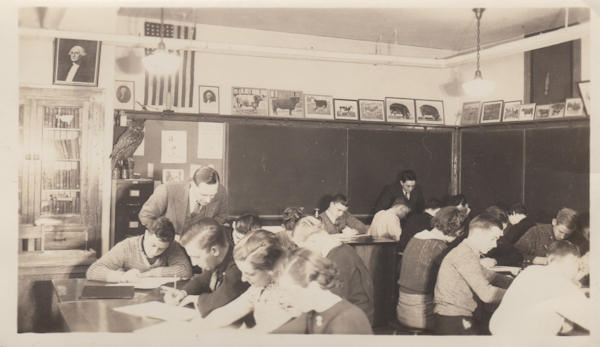
As Oregon continued to grow, so did its schools. By 1922, crowding once again forced expansion. The Red Brick High School rose nearby, built by Hayes & Langdon of Janesville at a cost of $74,777, with another $6,000 for equipment. It was used solely for high school courses, while the 1895 building continued serving elementary students. The new structure included a large gymnasium and an auditorium seating 600, quickly becoming the scene of basketball games, community plays, and band concerts. That same year, enrollment jumped by 25%, from 125 to 150, signaling a village firmly stepping into the modern age.
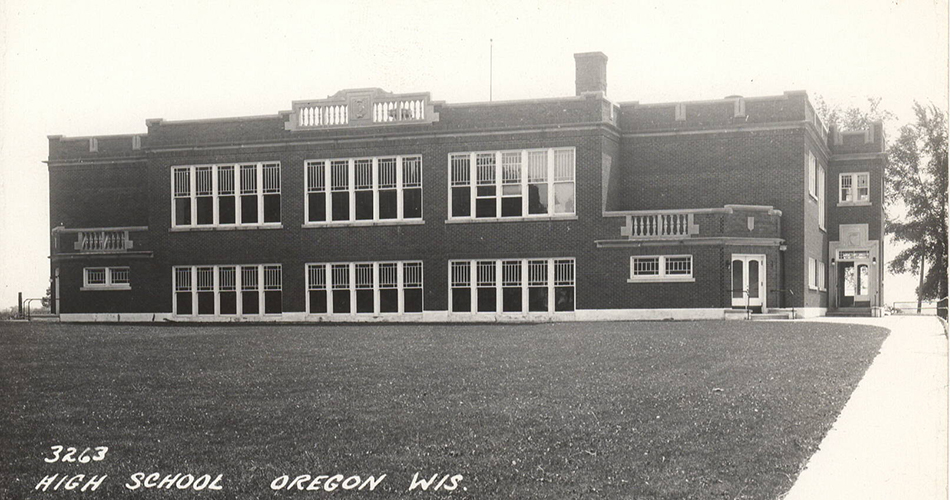
This building also became a community center for social activities. The basketball team moved from Cronk’s Opera House and the bicycle factory to the new gymnasium in the Red Brick School. Graduation ceremonies, band and orchestra concerts, class plays, large community productions, and proms took place at this school.
The building served as a high school until the mid-60’s. Space was then used as part of the elementary school until 1993. After that the Red Brick provided storage space.
It was added to the National Register of Historic Places in 1998. After several options were considered, the building was sold to the Gorman Company. In 2006-07, the Gorman Company began renovating the building, and in 2008 the building became their corporate headquarters.