
This year marks America’s 250th birthday. The Oregon Area Historical Society and Museum (OAHS) applied the America@250 Initiative and we were lucky enough to receive a $500 grant!
To celebrate America’s birthday, we are hosting events and planting a Three Sisters Garden!
Events
Community Conversation – Our American Story
Monday, June 29
2:00-4:00pm, Oregon Public Library
Three Sisters Garden
Seventy-seven years after the American Revolution, in 1848, Wisconsin became a state. When the American Revolution kicked off and for a long time after, this land was Ho-Chunk.
The Three Sisters garden is a traditional Native American agricultural practice that involves planting corn, beans, and squash together. The corn acts as a trellis for the beans. The beans take nitrogen from the air and fixes it in the soil to nourish the corn and the squash. The squash vines along the ground and acts as mulch, shading the ground, trapping moisture, and preventing weeds. The three plants grow better together than separately, a practice that today, we would call companion planting.
Archaeological evidence suggests that the Three Sisters planting was practiced as early as 1070 A.D., at least 500 years before contact with Europeans. The practice spread over many generations, eventually becoming common practice among indigenous people throughout North America. This innovative agricultural practice kept indigenous peoples fed for generations and is still in use today.
This garden is a celebration and living museum! We have not grown a Three Sisters garden before, and if it does not work, it is clearly our error and not the well documented practice. We are not tribal members. We are amateur historians who want to honor the resilience, ingenuity, and traditions of those who have come before us.
What We Planted
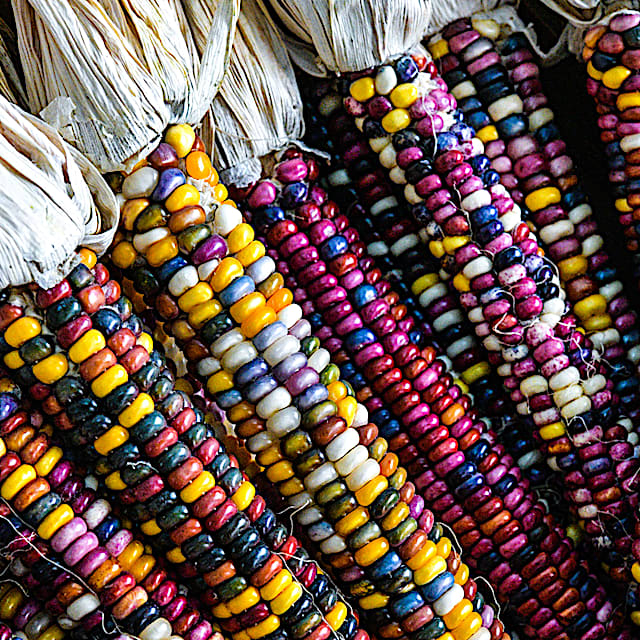
Northern Lights
Image from Rareseeds.com
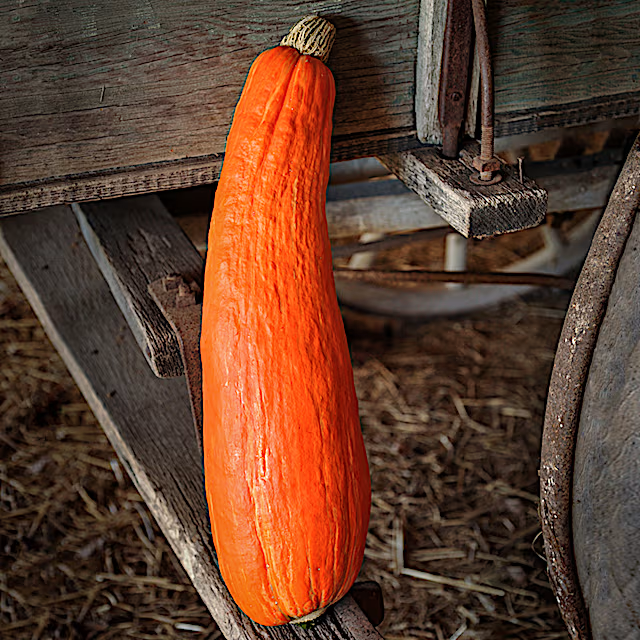
Gete Okosomin Squash
Image from Rareseeds.com
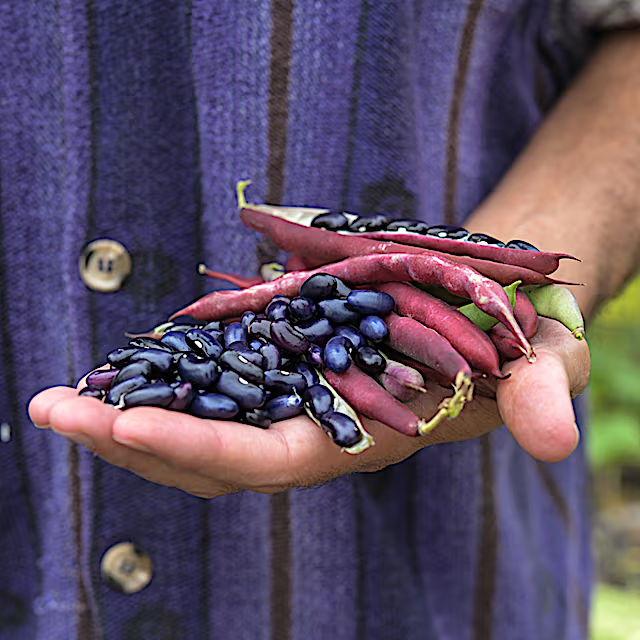
Cherokee Trail of Tears Pole Beans
Image from Rareseeds.com
Northern Lights Flint Corn
Dent or flint corn is often used when planting a Three Sisters garden. The corn stalk needs to be strong to support the beans and the kernels are traditionally harvested, dried, and stored for later use, usually for grinding into cornmeal. Other corn varieties, like sweet corn, have tender kernels that do not dry and store well. We selected Flint Corn Northern Lights (Zea mays) which is a flint variety known for its beautiful multi-colored corn. While edible, we’ll likely dry and store any corn we grow for decorative purposes. The six- to eight-inch ears mature on four- to five-foot sturdy stalks.
Gete Okosomin Squash
We were very excited to find that Gete Okosomin (Cucurbita maxima) was available for purchase! Roger Smith brought seeds to the National Heirloom Exposition in 2015 and this variety is famous as the “800 year-old squash,” with a story that the seeds had been found in a buried clay ball here in Wisconsin. In fact, this banana type Native American variety has been stewarded by the people of the Miami Nation in Indiana for countless generations. Its name translates to “cool old squash” in the Anishinaabe language. The magnificent bright orange fruit with lighter orange striping, can grow up to 3 feet long!
Cherokee Trail of Tears Pole Bean
For pole beans, we selected Cherokee Trail of Tears (Phaseolus vulgaris). This drought-resistant vine is a heavy producer with black beans that grow in pods that ripen red to violet. Notably these beans were taken to Oklahoma by the Cherokee during their forced death march from their ancestral homelands of the Southeast to Oklahoma in the 1830s. The tragic and deadly forced migration killed more than 6,000 people. People couldn’t carry much, but they did take seeds, including a shiny black bean that came to be known as “Cherokee Trail of Tears.” Dr. John Wyche, a Cherokee tribal member, dentist, and seed saver from Hugo, Oklahoma, gave the beautiful and prolific bean variety to Seed Savers Exchange in the 1970s. His family had stewarded the bean for generations in Oklahoma.
Resources Referenced: