
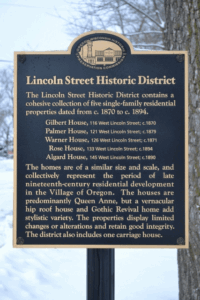
The Lincoln Street Historic District in Oregon contains a cohesive collection of five single-family residential properties dated from c1870 to 1894.
The Setting
 At the end of 1842, Bartley Runey, his wife, three boys and four girls, and Robert Thompson were the only residents in the Township of Oregon.
The next year, 1843, C. P. Moseley settled on the present site of the Village of Oregon, built a cabin and opened a tavern on the old territorial road running from the lead regions near Dodgeville to Milwaukee. This log cabin-tavern became the stopping place for teamsters drawing lead to market. This stop became the nucleus of the thriving Village of Oregon.
The population of the Village was enlarged in the year 1844 by the arrival of Reuben Boyce and family in Section 36, Stoddard Johnson in Section 1, W. F. Lee and Schuyler Gilbert in Section 10. By 1845 Joseph Algard and family had settled on Section 17. Also in 1845, Nathaniel Ames, his three sons and grandson, arrived in the area. These early pioneers are identified with the history of Oregon, having witnessed its gradual development and growth. Other families prominent among the first settlers were J. S. Frary, S. J. Pratt, Abraham Kierstad, W. S. Bedford, Roswell Babbitt, Phineas Baldwin, R. P. Main,E. W. Dwight, Tipple, Hook and Fox.
The original plat of this Village was surveyed on the lands of Charles C. Waterman, William S. Bedford, A. S. Mygatt and John D. Tipple. Additions were made by S. S. Johnson, Abraham Kierstad, E. E. Bedford, William S. Bedford and L. W. Parson.
Johnson’s Addition
The West Lincoln Street Historic District is a part of the Stoddard Johnson Addition to the Village of Oregon. At the time the surveyed land was recorded, on September 10, 1863, the street name was listed as Third Street. The map indicates the location of the various properties surveyed within the Johnson Addition. This property was originally part of Mr. Johnson’s 40-acre farm. It was when the Methodist church was first organized that Mr. Johnson had his property surveyed. He gifted his property on the corner of First Street and North Main Street to the Methodists for them to build their church.
Stoddard Johnson was born in 1807, location unknown, and died in Oregon in 1879. He is buried in Prairie Mound Cemetery, Section 2, Lot 153 and Grave 2. Also in Section 2, Lot 153, Grave 3 is a Patty Waite Johnson, born 1789 and died 1852, and an infant Isaacs Johnson, born 1847 and died in 1848, buried in Grave 4.
Today, the Lincoln Street Historic District is located along West Lincoln Street in downtown Oregon. The district consists of five single family residential properties dating from c. 1870 to c. 1894. All of these residences are contributing elements within the historic district, which is located west of North Main Street and east of Market Street. The architectural style of the district is predominantly Queen Anne but a vernacular hip roof house and Gothic Revival home add stylistic variety.
The properties along West Lincoln Street are primarily residential with the exception of the Oregon Area Historical Society, which was historically a railroad hotel. The Chicago and North Western Railroad, finished in 1864, runs parallel to Market Street. The depot was located at the intersection of Lincoln and Market Streets, west of the railroad tracks. The setbacks within the district average 25 feet, and mature trees line the sidewalk terrace. Four properties feature clapboard siding and the remaining house is constructed of brick. The properties display limited changes or alterations and retain good integrity. The district also includes one contributing garage and three noncontributing garages and sheds that were constructed outside the period of significance.
The district contains a cohesive collection of residential properties built by prosperous individuals whose involvement in local commerce and politics enabled them to build significant residences in the late nineteenth century. The homes are of a similar size and scale, and collectively represent the period of late nineteenth century residential development in the village.