
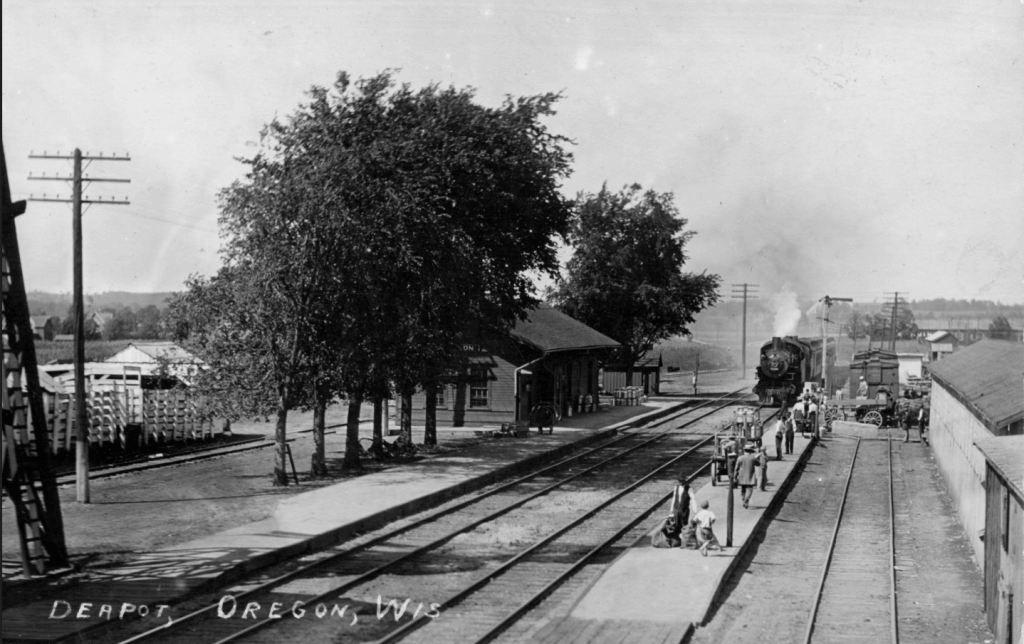
The main railroad line from Chicago to Minneapolis, the Chicago and North Western Railroad came through the village in 1864. From 1880 to 1950 the line was double tracked, but mostly abandoned between Evansville and Madison in 1996 when it was reactivated from Madison to Oregon, to serve the Lycon Concrete Plant in 2014.
The Beloit and Madison Railroad (later part of the Chicago and Northwestern) extended the line through the village, giving Oregon an advantage over the outlying settlements. Oregon was an important nucleus of trade, a shipping point for livestock to the Chicago market (1890-1930). At the height of rail activity about 15 carloads per week of livestock went out of Oregon. Grain shipments of wheat and oats numbered about 100 cars/month.
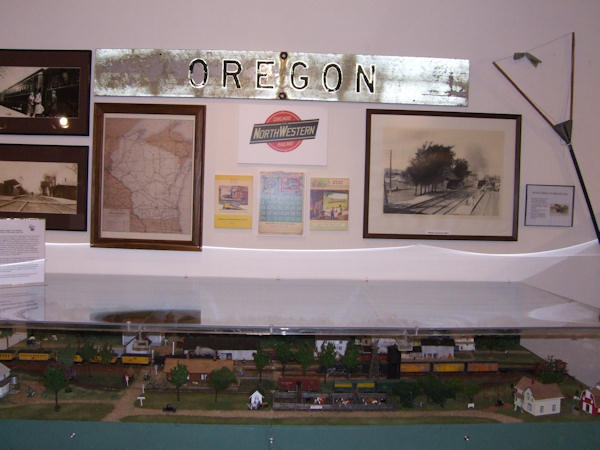
The museum has a model train depicting the area of the depot and railroad yards of Oregon in the early 1900’s. The exhibit was suggested by Bob BOomsma and then created by Don Swinton, Larry Enlow, Tom Eckstein, and Paul Mangan, members of the South Central Wisconsin Division, MWR-NMRA. They created this wonderful diorama exhibit to showcase the significant story of the railroad coming to Oregon in the mid-1860’s. Larry and Sue Bunce donated the Wisconsin railroad map, train order pole, dishes, lamps, and other railroad items.
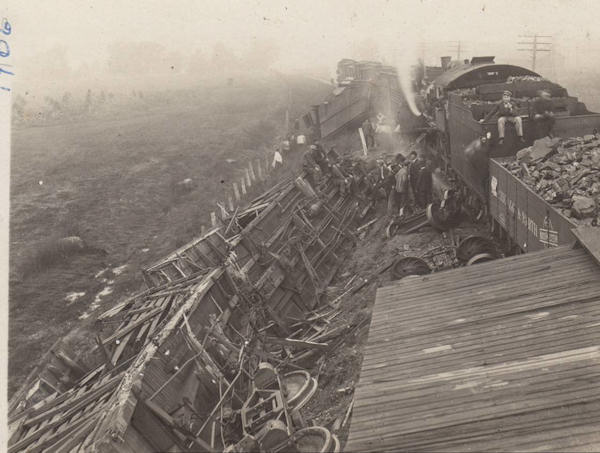
In the early years, communities along a railway line occasionally witnessed a train wreck or derailment, and the Oregon area was no exception. Pictured here is a derailment that occurred in 1906. Does anyone have any more details about this wreck?
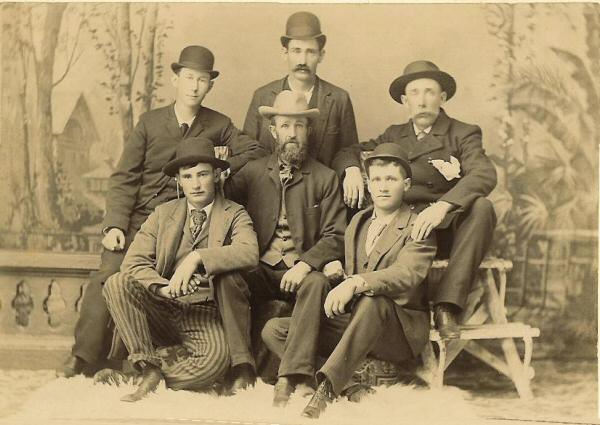
This photo is from 1910 and is of Patrick J. Landers, a foreman on the railroad, and his section gang.
The 1910 census shows Landers is 49 years old and his household in Oregon includes his wife Erigence, age 45, Violet and Brulah, both age 15, and Pansey, age 11. Probably living in the home as boarders are Earl S. Smith, age 20, and Charles Piller, age 38.
If anyone can identify the other individuals in the photo, please contact the OAHS at 608-835-8961.
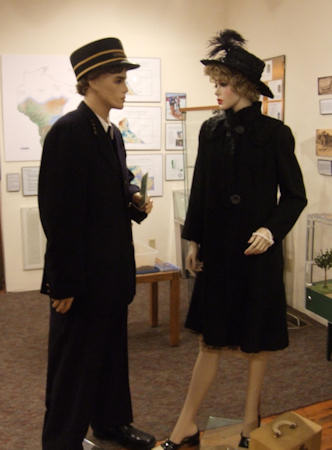
Dick Richardson and his father, Merle, both worked for the Chicago and Northwestern Railroad. Merle received a deferment from service in WWII because of his job with the railroad. The railroad was considered of major importance during the war effort. Merle worked for the railroad for 34 years.
The conductor was the train’s “bookkeeper.” At the end of their trips, the conductor on a passenger train was responsible for reporting to company officials, informing them of the number of passengers, arrival and departure times. They also collected tickets or cash for fares and provided passenger with information
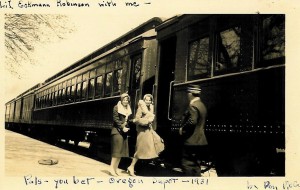 A look back to when Oregon had a passenger train! Lil Eckmann Robinson and Marie Frisch boarding a train at the Oregon depot in 1931, probably going to Madison. This photo was taken by Don McGill.