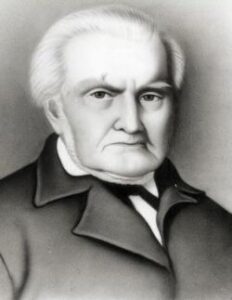
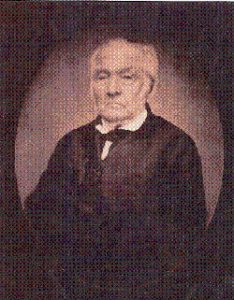
A Sketch of the Life of Nathanial Ames
Dictated to R. P. Main and presented to the Oregon Area Historical Society by Marion and Alice Ames
Small booklet, 4-1/4 x 5-1/2, beige with string binding. Printed by Teller Print, Brooklyn, Wis. Original at OAHS Museum.
Transcribed by Melanie Woodworth, 6 Feb. 2011 for the OAHS
I, Nathaniel Ames, was born April 25th, 1761, in Killingsby, Connecticut (Note in margin – corrected, change to Scituate, Rhode Island). My father’s name was David Ames. At the age of six years I was given to my grandfather, who had lost a son in the French War, after whom I was named, who lived in Stonington (now N. Stonington). I lived there until I was eighteen years of age. I then enlisted in the Continental service for the campaign of 1779. At the expiration of that campaign I agreed to take the place of a soldier who had enlisted for three, and fill out his term of service, he having a family and wishing to go home to them. I finished his term of service and received a three years’ discharge by Com. Major Walbridge. During that winter 1780, known as the cold winter, our regiment was sent from the barracks in Morristown to Wood, N.J., the line. (At my first enlistment I joined the army at Van Blancks Point, opposite West Point.)
I then enlisted in the campaign of 1780 in Colonel Starn’s regiment and served as quarter-master’s sergeant. We removed to the place where Major Andre was hung. I saw the execution, which took place in front of a stone church; I think it was called Tarrytown. I can remember Washington, whom I have seen often. I can recollect Steuben and his black horse. I have seen Arnold. I remember Colonel Ledgard, served one month under him and helped build Fort Groswold, opposite to New London, in Connecticut.
After my discharge in 1780 I returned to Stonington. (I served one month as a guard at Stonington previous to enlisting.) In the spring of 1781 I went aboard of a 16-gun brig by the name of Lafayette on her first cruise; captain’s name, Trotter; sailing master, Watsons; first mate’s name Sharp. It was a privateer; one-half of the prize was to go to owners of the ship, the balance to be divided among the officers and crew. We proceeded from New London to Newport. I was very sick on the way and determined when I got on land again to stay there. We arrived there that evening. The French fleet commanded by Haverdgrass entered the harbor. Washington met him and had an interview with him.
The city was illuminated. I went to a tavern to lodge and was awakened early in the morning by a noise which proved to be the wooden shoes of French soldiers. We remained in harbor and left with the fleet. As we went to the harbor we parted. The fleet went toward Cornwallis, we proceeding to sea. After a few days we fell in with an English brig bound for New York. We sent her for New London but she was retaken by the British and sent to Halifax and the crew made prisoners. We then fell in with a sloop of but little value. Her crew was made prisoners and I among others sent aboard her. During a storm I was washed overboard, there being a place cut out of the gunwhale to take in a hogshead of molasses, but I caught by a piece of rigging and was taken aboard. We then proceeded to New London.
Next year (1782) we continued privateering. We took and sent to New London two prizes, one a fine ship, but before she was sold Arnold made an attack upon and burned New London and the ship. In the fall of ’83 I went aboard a merchant ship for the West Indies. We went to the Bermudas, did our trading and started for home, but was taken by a refugee ship and taken back to the Bermudas and kept a prisoner for three months.
That year I shipped aboard a merchant ship under an English captain in the fall, returning in the Spring, then shipped in a large brig with a deck load of horses for Madeira, the hold filled with walnut or hickory wood for Gibraltar. Went to Madeira and traded horses for wine, went to Gibraltar, delivered our wood and sent our wine to England. We stayed at Gibraltar three months, From Gibraltar we went to Turkey, took a cargo of seventy mules, returned to Gibraltar and remained until the wind became favorable so we could go through the straits, as the current which runs into the Mediterranean is so strong that no ship has ever been able to beat out through the straits. We then steered for South America. Our first mate sickened and died and finding no sale we steered for the West India Islands, landed at Guadolope (located at Point Peter) discharged our cargo and took a cargo of molasses. There I had the yellow fever and came near dying. We steered for home and arrived in New London all safe. We were there discharged.
I then went up the North or Hudson River and stopped at Bathtown. There I went to school three months. The next season I took charge of a sloop to run between New York and Albany. At the first trip I run her to Half-Moon Point, a feat that had never been done before.
After that season I left the water. My mind became exorcised on the subject of religion. I had an extraordinary dream. I then went to farming, having hired a farm in partnership with a man with a family. He hired a girl to work for him by the name of Sarah Hall, the sixth daughter of Thomas Hall, her father being now dead. In the following February we were married.
Soon after this the Methodists were holding meetings in the neighborhood. Myself and wife experienced religion. Soon after I joined what was then called the Wesleyan Methodist church. I was appointed a class-leader and soon went to preaching. I was about thirty years of age. Soon after this I moved to Steuben, Oneida County, New York, where I continued to preach, until I was about seventy-five years of age. I never received to the amount of five dollars for preaching.
When I arrived in Steuben I had five children, two sons and three daughters; in Steuben I had six children, four sons and two daughters.
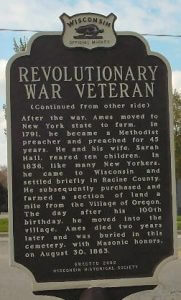
In the summer of 1844 I left Steuben and came to Wisconsin and bought of the government 320 acres of land in what is now the town of Oregon, Dane County, the land being mostly all subject to entry.
My grandfather’s name was Cornelius Waldo, uncle of Jonathan Waldo.
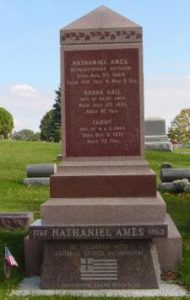
Nathaniel Ames died at Oregon Wisconsin, at the ripe old age of one hundred and two years and was buried in the Oregon cemetery where his grandson, John N. Ames, erected a beautiful monument to his memory.