The Oregon Area Fire/EMS District (OAFED) has a history that spans over a century, illustrating its growth from humble beginnings to becoming a vital emergency service provider.
Thanks to Richard Anderson for preparing some of the information on this page which was donated by the Anderson family in 1998.
Jump to the list of Fire Chiefs.
Early Documented Fires
- Autumn of 1864 – The building that housed Gilbert Johnson’s business and residence on the Main Street square burned to the ground.
- Spring 1870 – The post office, general store run by Huntington and David Tipple, and another general store run by B.W. Beebe burned.
- July 4, 1873 – A large fire destroyed five buildings on North Main St. The three one-story and two two-story buildings were owned by Frank Nott, Patrick Nangle, and C.W. Netherwood.
- September of 1873 – The R.P. Main house (formerly owned by John D. Tipple) burned to the ground. The Portland Hotel – J. Olson Corner later occupied this site.
- Summer of 1874 – The Thomas Zook house in the Southern part of the village burned down.
- May 28, 1880 – Three buildings on South Main street were destroyed. How Brothers and H.J. Smith owned these buildings. They were occupied by Isaac Howe’s Drug Store, H.J. Smith’s furniture store, and Case and Warner general merchandise.
- Early 1880s – This decade saw many large fires in the Village. The old hotel, the hotel barn, and the Netherwood building on Main Street burned down. The freight near the depot, the Wischhoff Corner, the old Brewer house west of the Presbyterian Church, the Will Robinson house on Janesville Street, and the P.C. Peterson and Page homes on South Main Street were also lost to fire.
At the time, the Village was experiencing a period of growth. The increase in population and the increase in fires confirmed the need for a better and more systematic form of fire protection. Around 1886, the Village invested $150 in a number of fire extinguishers. They were placed in protective boxes on street corners, thus making them accessible to the public in case of a fire emergency.
Early Beginnings (1888-1919)
In February 1888, the first reference to Oregon’s fire department appeared in the village minutes, marking the purchase of basic firefighting equipment, including ladders, pike poles, and ropes. By March 14, 1894, the Oregon Engine Company No. 1 was formally organized with Hartley Criddle as the first fire chief, who also operated the Portland Hotel. Other officials included: William Soden, Bob McGill, Reuben Graves, C.W. Netherwood, E.G. Booth, and W.E. Runey. Their duties were to “watch horses and horse carts and to get help to pull them.” Steward Barney McDermott was responsible for furnishing refreshments at fires. A constitution and bylaws were inacted. Membership was limited to 50 men.
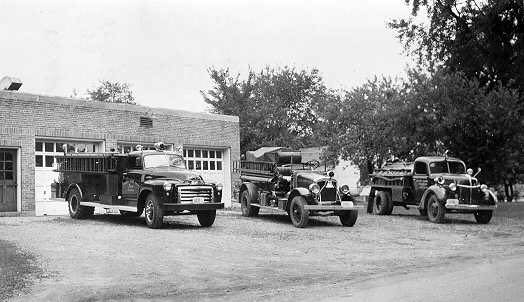
Part of an old wooden school house was moved to the present site of Maria’s Pizza in 1895 and became Village Hall. The Fire Department occupied the downstairs of the building. The belfry held the bell to sound the alarm for fires.
A hook and ladder company and a chemical company were organized in 1896. The village was divided into fire wards. The hook and ladder were useful in fighting small roof fires, but following a few more uncontrollable fires, a large hand pumper operated by 12 men was purchased.
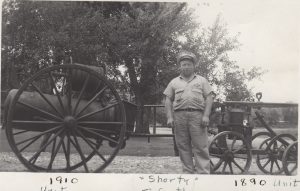
In this photograph, Emmett “Shorty” Erfurth is shown in front of a water cannon purchased in 1910 and a 12-man Niagra hand pumper purchased in 1895. By frequently changing the crew, the firemen were able to throw a pretty strong hose stream of water from especially prepared and tank-and-team-filled cisterns scattered over the Village. These cisterns were replenished after every fire. Previous to acquiring a 12-man pumper, the department used individual hand pumps.
The department grew quickly. In 1897 George Theobald was elected fire chief. Fire fighting services were updated when a system of pipes was laid. A contract was made with the Badger Cycle Company, the owner of the well on site of the present downtown water tower, to draw water when necessary from three newly installed hydrants.
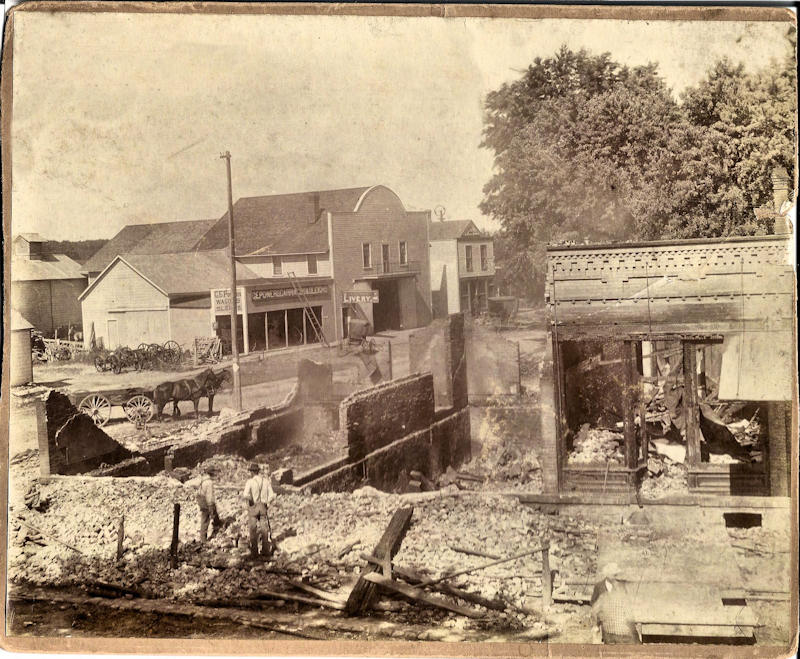
The new fire department battled two large fires in 1898, the Netherwood Building located on the corner of North Main St and Jefferson Street, and an elevator. When the elevator fire occurred, the City of Madison sent fire equipment to Oregon on railroad flat cars.
The tower and water mains system went into effect in 1898 and 1899. A no. 6 hose cart was purchased in January 1900 from the New York Hose and Packing Company. A major fire occurred in May 1906 when the Oregon Hotel, located at the present site of the Oregon Area Historical Society & Museum burned to the ground.
In 1911, an automatic fire alarm system was installed and operated from the Oregon Telephone Company. Volunteer firemen, many of whom were local businessmen, dropped what they were doing and raced to the fire station when the fire whistle signaled there was a fire in the vicinity.
The old Village Hall and fire station building (at the site of Maria’s Pizza) moved to the present community building in 1915. At the time a fire siren was mounted on the cross beam of the water tower. It also was operated by the telephone company. This siren was removed in 1941. In 1918, the fire department attend four fires, and in 1919 the firemen fought two fires.
Expanding Equipment and Capabilities (1920-1959)
The 1920s saw tremendous growth in both the size of the department and the sophistication of its equipment. The department’s first fire truck was purchased in 1925, a Dodge chassis equipped with a 300-gallon tank. This was the first fire truck in the county. In 1926, a Chevrolet ladder truck was purchased and the following year another truck for ladders was purchased. In 1928, Roy Pease was elected fire chief and Pirsch triple-combination pumper in with a 150-gallon tank and a 500 gallon per minute pump was put in service in 1929.
In 1933, the Oregon Fire Department took on a new role as a community leader by helping to establish a swimming pool, which was dedicated in 1934. This pool, operated by the firemen for 27 years, became a central part of the community.
Rural fire services also expanded, with a Ford tank truck purchased in 1939 to better serve farm areas.
After a fire destroyed the John Sholts house in early 1939, an effort began for a tank truck to use especially for fighting rural farm fires. The Oregon Fire Department presented this idea to four adjacent townships. Ivan Rasmussen and Pat Morrissey, agricultural teacher were instrumental in helping Norton T. Ames sell the idea. Under the direction of John Dueking, Erving Gallagher, and George Ingraham, a For chassis and tank were purchased to be owned by the townships.

The 1940s were another era of expansion, with a new Village Hall that included fire and police stations. During the summer of 1942, as a ware measure, county training was started. The instructors traveled about the county on war-rationed gasoline.
The department continued to innovate, purchasing their first oxygen masks in 1947. In 1948, and in cooperation between the Village and neighboring townships, the Fire Department expanded again. A GMC truck in 1948 equipped with a 900-gallon tank and 500-gallon-per-minute pump was purchased. The Village paid one-third and the townships two-thirds of the cost. This was the first tank truck for the fire department service in rural areas in Wisconsin and the first tank truck outside of Milwaukee County.
In 1949, Oregon firemen gave the first demonstration of wetter water. This is a wetting agent added to water to break down the surface tension. Oregon was one of the first Class A approved rural fire departments in the state, which gave the department credit on rural fire insurance.
Training and Technological Advances (1950-1969)
The 1950s were a period of professionalization and training for the department. Oregon held the state’s first advanced firemanship course in 1950, followed by the first instructors’ school for basic firemanship in 1955. During this period, the department also upgraded its equipment, acquiring a truck capable of pumping 750 gallons per minute. In 1955 and 1956, after legislative approval of firemanship training appropriations, Oregon was the site of two instructive schools. Don Bunnell, GLen Campbell, Don Xander, Lloyd Bavery, LaVerne RInghand, John B. McManus, and Normal Champion qualified as instructors under the state training program and taught other departments.
In 1958, five fire alarm telephones were put into use. The telephone number was #5-3113. Three of these phones were in business places and two were in the homes of firemen. The fire sirens could be set off by any of the phones.
By 1959, Oregon became the first department in the state authorized by the FCC to operate and transmit base and mobile radios. Also in 1959, two mouth-to-mouth breathing apparatus and a pneuolater, which is used for breathing problems were added to the department’s equipment.
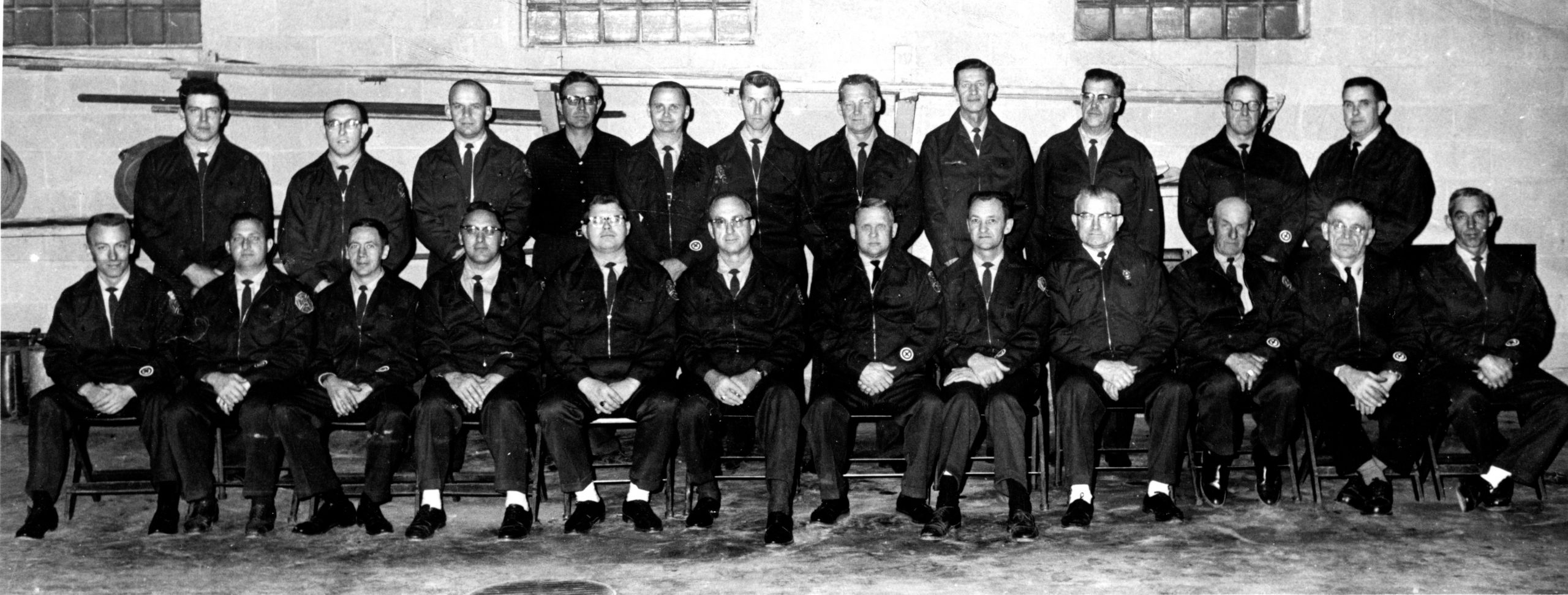
In the 1960s, Oregon’s fire services expanded into a formal fire district, created in 1963 in collaboration with the townships of Oregon, Dunn, Rutland, and Fitchburg. A new fire station opened in 1966, signifying a growing commitment to fire safety and district-wide collaboration.
Modernization and EMS Integration (1970-1999)

The 1970s saw further modernization of firefighting techniques and equipment. The department installed communication radios in its rescue trucks in 1970 and improved its fire alert system in 1972. That same year, the department acquired its first Self-Contained Breathing Apparatus (SCBA) and established the Oregon EMS department in 1978.
By the 1980s, Oregon’s fire department continued to embrace technology and safety innovations, purchasing the Jaws of Life in 1981 and introducing firefighter turnout gear in 1987. The department also grew in diversity, with two women joining in 1989, marking a historic milestone.
In 1995, the Oregon Fire Department and Oregon EMS officially combined, forming the Oregon Area Fire/EMS District (OAFED). The district hired its first full-time fire chief and two firefighters by 1999, marking the shift to a more professional and full-time emergency service provider.
Growth into the 21st Century (2000-Present)
Entering the 21st century, OAFED continued to expand its facilities and capabilities. A major building addition was completed in 2002, including an ambulance bay, offices, and living quarters. The Oregon EMS service was upgraded to an Advanced EMT level in 2003, allowing for more advanced care.
In 2004, OAFED introduced an internship program, offering young aspiring firefighters and EMS professionals the chance to gain critical certifications and experience, fully paid by the department. This program has successfully prepared many for full-time careers in the field.
In recent years, OAFED has added specialized rescue equipment, including ice rescue and grain bin rescue tools, enhancing its ability to respond to emergencies in a wide variety of situations. The district now operates a fleet of modern apparatus, including two Class A fire engines, a 3000-gallon tender, and brush trucks equipped for wildland fires. The district responds to approximately 1200 emergency calls annually, providing essential fire and EMS services to the Oregon area.
Community Engagement and Education
OAFED plays an active role in the community, offering a range of educational and safety programs. These include CPR/AED training, fire safety programs, and public engagement activities like National Night Out and the annual Pancake Breakfast. The department also offers tours, hosts birthday parties, and supports local businesses with pre-planning for emergencies.
In 2019, the department celebrated its 125th anniversary, a testament to its long-standing commitment to serving the Oregon area with excellence and dedication.